Anthropic recently published research that stopped a lot of people mid-scroll.
Their data shows that for business and finance roles, AI can theoretically handle 94% of tasks. For management, 91%. For legal, 89%. For office and administrative work, 90%.
In practice? Actual usage sits closer to 33% in most of those categories.
That is the gap. And it is not small.
Theoretical AI capability
Business & finance: 94% · Management: 91% · Legal: 89% · Office & admin: 90%
Observed real-world usage
Actual adoption across most of those same categories: closer to 33% of what is theoretically possible.
What the research actually shows
Anthropic introduced a metric called “observed exposure” — comparing what AI could do theoretically against what it is actually doing in real professional settings. The result is the radar chart below: a large blue area of potential, and a much smaller red area of actual use.
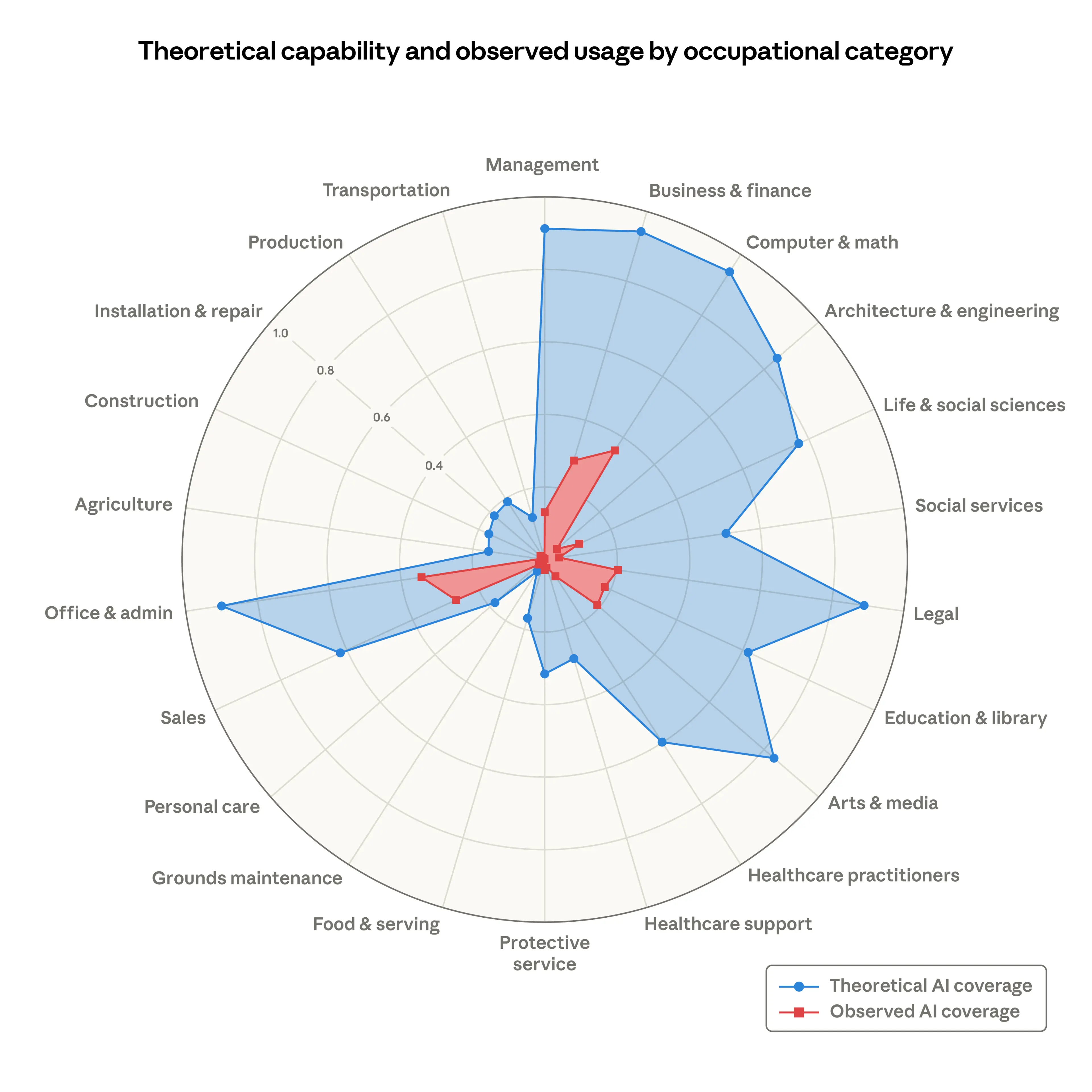
In most sectors, actual adoption remains only a fraction of what AI is theoretically capable of doing. The reason is not that the technology is not good enough. The gap is evidence that we are still early in the adoption cycle. Closing it requires new workflows, new integrations, and someone who knows how to connect the tools to the way a business actually operates.
Most businesses are not struggling with what AI can do. They are struggling with how to use it inside real workflows.
Why this matters for small businesses
Most of the coverage of this research has focused on white-collar jobs and enterprise organisations. But the gap is just as real, arguably more so, in the kinds of businesses we work with every day.
A trade business has the phone ringing while someone is on the tools. An accounting firm has enquiries sitting in an inbox on a Friday afternoon. A property manager has maintenance requests arriving at 10pm. In every one of those cases, AI has the theoretical capability to handle the response, qualify the lead, and route the right information to the right person.
It just has not been set up to do it.
That is the implementation gap in its most practical form. Not a question of whether AI is capable. A question of whether anyone has taken the time to build the system properly inside a real business.
What we are actually seeing
The data from Anthropic reflects what we see on the ground every week. Leads go unanswered. Follow-ups get missed. Calls drop after hours. Not because AI cannot solve these problems. Because it has not been properly implemented.
- A trade business receiving 20 calls a week, losing 8 of them to voicemail after hours
- A professional services firm with a database of 400 past clients it has not contacted in two years
- A real estate agency where every open home lead gets a follow-up call three days later, if at all
In each case the capability exists. The system does not.
The opportunity hiding in plain sight
The businesses that move now are not waiting for AI to get better. They are closing the gap between what is already possible and what is actually deployed.
That means responding to every enquiry within 60 seconds, not the next morning. Following up on every quote automatically, not when someone remembers. Capturing every after-hours call, not losing it to a competitor who picked up.
None of that requires cutting-edge technology. It requires proper implementation.
Most businesses are using a fraction of that.
The bottom line
Anthropic’s research is a capability map. The blue area is what is possible. The red area is what most businesses are actually using.
The gap between them is not a technology problem. It is an operational one. And operational problems have operational solutions.
The businesses that close that gap first will not just be more efficient. They will be structurally harder to compete with.
Read the full research at anthropic.com →